
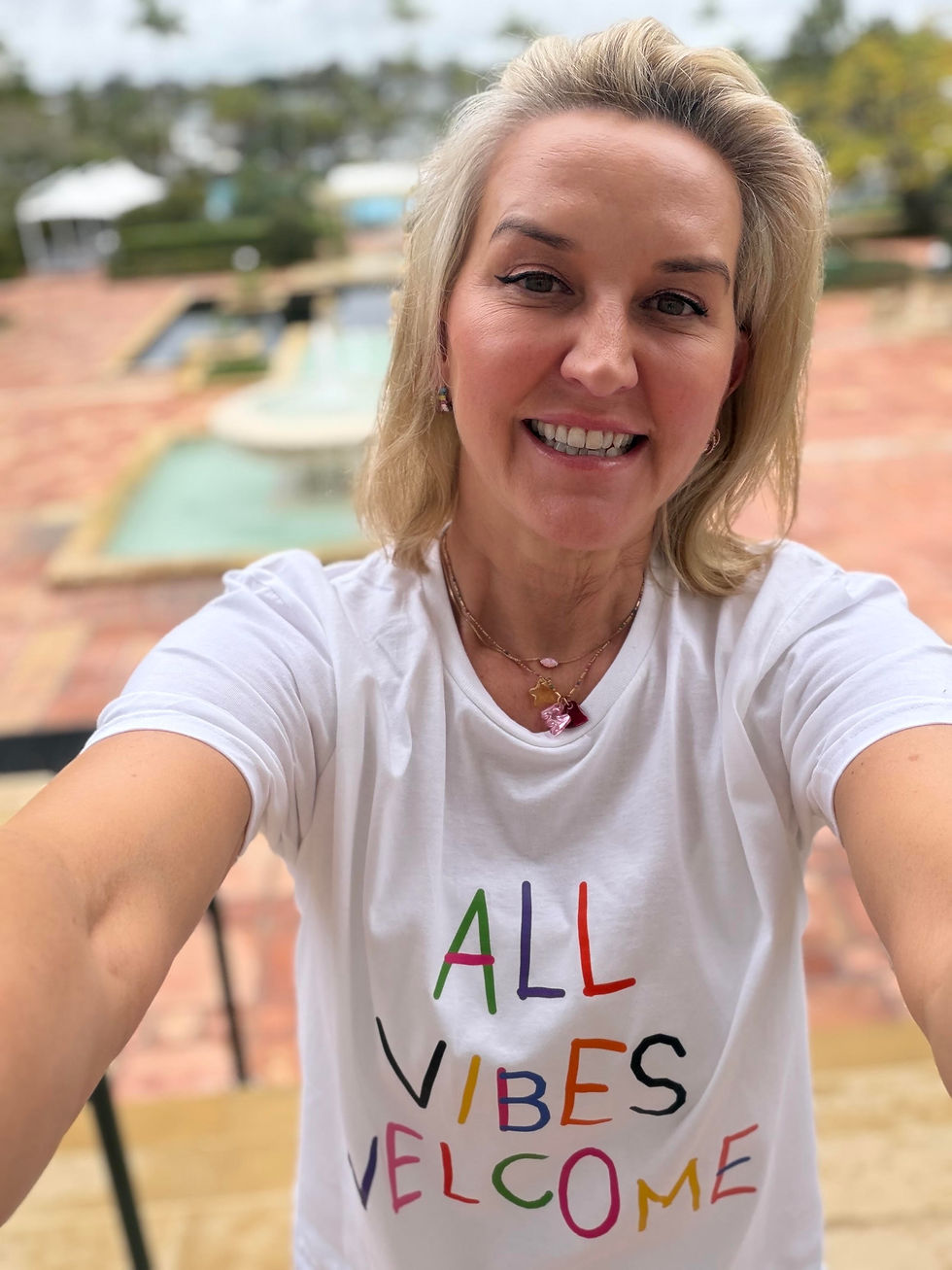
All vibes welcome
(Not good vibes only)
Emotions are NOT good or bad. They're NOT positive or negative,
or right or wrong.
Emotions just ARE.
Some feel comfortable and some feel uncomfortable. All of them are temporary.
And every emotion has a purpose. Emotions communicate to other people, and they communicate to us, telling us what matters and what we need. Each one comes with an action urge: fear urges us to protect ourselves, sadness to slow down and reach for comfort, and anger can urge us to stand up, set a boundary, or advocate for ourselves and others.
There's a common belief that happiness means avoiding "bad" feelings. Avoidance works for discomforts like hunger or cold, but with emotions it backfires: the harder we try to control, numb or escape distress, the more intense it often becomes. It's like being caught in a rip. The harder you swim against it, the more exhausted and anxious you become. Or like a finger trap: the harder you pull, the tighter it grips, and it's only when you ease in that it lets go.
Sometimes the way through isn't to fight harder, but to pause, notice and respond differently. Some feelings we float through. Others we surf, riding the wave with skill rather than letting it crash over us. When a strong emotion arrives, we don't have to obey it, suppress it or escape it. We can acknowledge it, feel it, and choose how to respond.
In my work with schools, psychologists and people of all ages, I'm interested in helping people notice their feelings, name them and make room for them. I'm not interested in hurrying anyone back to happy.
At the heart of Dialectical Behaviour Therapy (DBT), and everything I do, is holding two things as true at once:
You are doing the best you can,
AND
you can learn new ways to cope.
Uniquely you
Every one of us is unique. We may share similarities and experiences, AND we each have our own shape, history and wiring.
The puzzle piece
Imagine you're a uniquely shaped puzzle piece: complex, sensitive and richly textured. But the puzzle you grew up in was made for simpler shapes. You were told to shave off your edges, flatten your depth and match the others. You tried. You masked. You started to doubt your own shape, and eventually stopped trusting that you belonged anywhere.
Many people who feel emotions intensely know this experience. Not because they're broken, but because their emotional wiring didn't match the environment they grew up in.
Together we can work on reclaiming your shape, and finding spaces where it's safe to belong.


Photo: Dr Madeline Wishart, Surf Beach, Phillip Island
An echidna's spikes aren't there to hurt anyone. They protect a soft, vulnerable underbelly. When an echidna feels threatened, it curls up or digs in, spikes out. It isn't being difficult; it's keeping itself safe.
Many of the ways we cope work the same way. Behaviours others find hard to understand, like pulling away, lashing out, shutting down or self-injuring, often grew for a reason: to protect something tender, painful, scary or hurtful. They made sense at the time, and they may still help in the moment, but they can come at a cost. Together we get curious about what the spikes are protecting, and build gentler ways to stay safe that cost you less.
My spikes protect the most vulnerable parts of me,
AND
I can learn gentler ways to protect them.
When I feel triggered, abandoned, lonely, scared,
hurt, ashamed, embarrassed or angry.
Marsha Linehan, who developed DBT, uses the image of a tulip in a rose garden. A tulip isn't a faulty rose. Both are beautiful and unique, and each thrives in different conditions. A tulip watered and pruned like a rose may struggle, not because anything is wrong with it, but because it needs different care. Given the right soil, light and space, it flourishes.
Or imagine being born gluten intolerant into a family of bakers. Everyone around you loves bread and shows care by baking for you, yet what nourishes them leaves you feeling unwell. No one is to blame, not the bakers and not you. It's simply a mismatch, and once it's understood, everyone can find new recipes that work.
When that mismatch isn't understood or supported, it can shape how we see ourselves, how we relate to others and how we cope.
Some of us are simply born more emotionally sensitive. We feel things quickly and deeply, and it can take longer to settle again. When those intense emotions are met with "you're so dramatic", "you're overreacting" or "you're too much", we can learn that what we feel can't be trusted. Often nobody is to blame. It's a mismatch between a person and the world around them. Over time, sensitivity and invalidation can feed each other, but that cycle can change. With understanding, validation and new skills, things can start to feel very different.
Part of our work together can be learning to ask for what you need, say no and keep your self-respect, while still caring for your relationships. It isn't about changing who you are to keep the peace. It's about knowing who you are and choosing, with intention, when to hold your ground and when to meet others halfway.
A tulip in a rose garden
